
Critical Thinking Brings Context and Clarity
Critical thinking is the hammer in the cognitive toolbox.

In times when you feel inundated with a flood of information and struggle to distinguish between what is accurate, misleading, or outright false, honing your critical thinking skills becomes invaluable. This ability allows you to sift through the noise, helping you identify facts, misinformation, and evidence-based content amidst the chaos.
One unusual way to stimulate critical thinking is by practicing the use of definitions to clarify terms and explore their origins to gain context.
Definitions
Utilizing online dictionaries and those integrated into your software is highly beneficial, even if you feel confident about a word’s meaning. Regularly checking definitions can help ensure that your understanding remains accurate and up-to-date. Additionally, cultivating an interest in the origins of words can greatly enhance your comprehension and appreciation of language, while giving you the added bonus of a history lesson on the term. (If you enjoy history, this is a great opportunity to decolonize historical accounts to include and value diverse perspectives.)
Here are a few definitions and their sources for critical thinking:
Critical thinking is the application of logical principles, rigorous standards of evidence, and careful reasoning to the analysis and discussion of claims, beliefs, and issues.
— Wiktionary, Creative Commons Attribution
Critical thinking is a widely accepted educational goal. Its definition is contested, but the competing definitions can be understood as differing conceptions of the same basic concept: careful thinking directed to a goal.
— Stanford Encyclopedia of Philosophy
Critical thinking is the ability to analyze facts, evidence, and arguments to form sound judgments or informed choices. It involves reflective and independent thinking, allowing individuals to evaluate their beliefs and make reasoned decisions.
— Wikipedia
Critical thinking is the ability to analyze information and form a judgment.
— Scribbr.com
Critical thinking (noun) the act or practice of thinking critically (as by applying reason and questioning assumptions) in order to solve problems, evaluate information, discern biases, etc.
— Merriam Webster
Why so many varying definitions? One of the definitions noted that critical thinking is contested with competing definitions which seems so illogical for a term that literally defines a skill to analyze and make sense of information.
Critical thinking, like so many information tools and resources, is a vital skill that can often be misunderstood in a society that tends to discourage deep reflection and informed decision-making. In many cases, there is a reluctance to promote independent thought, as it can challenge existing social structures and norms. This environment can hinder our ability to achieve clarity and context, which are essential for effective reasoning.
Importance
Critical thinking is essential for developing a more reflective and analytical society, making it crucial to introduce critical thinking tools to children from a young age. This early engagement equips them with the skills to form thoughtful and analytical viewpoints.
Many societies prioritize conformity and obedience over independent thought, often to maintain control. In such environments, compliance with authority simplifies governance for those in power, but this lack of critical engagement stifles creativity and innovation, hindering individual contributions. Furthermore, there is a prevalent skepticism about children’s ability to develop critical thinking skills. However, it is vital to understand that these skills can be nurtured. By promoting critical thinking, societies not only empower individuals but also strengthen the resilience and vitality of their communities.
“Critical thinking theorists agree that [critical thinking] is a teachable competency with a significant impact on various dimensions of knowledge and everyday life, both at the individual and societal levels” (Guamanga, et al. 2025).
Learning Objectives
Educational Priorities: Emphasize the importance of logical reasoning and the application of stringent standards for evidence. Encourage a thorough examination of beliefs, claims, and pertinent issues, promoting a mindset that is meticulously aligned with defined goals and objectives.
Critical Competencies: Develop the ability to analyze and assess facts, evidence, and arguments critically. This skill set is essential for forming well-founded judgments and making decisions that are informed and rational, thereby enhancing overall cognitive capabilities.
Reasoning and Evaluation: Utilize logical reasoning and challenge existing assumptions to effectively address problems. This involves a systematic approach to evaluating information and recognizing potential biases, which is crucial for achieving clarity and accuracy in understanding complex issues.
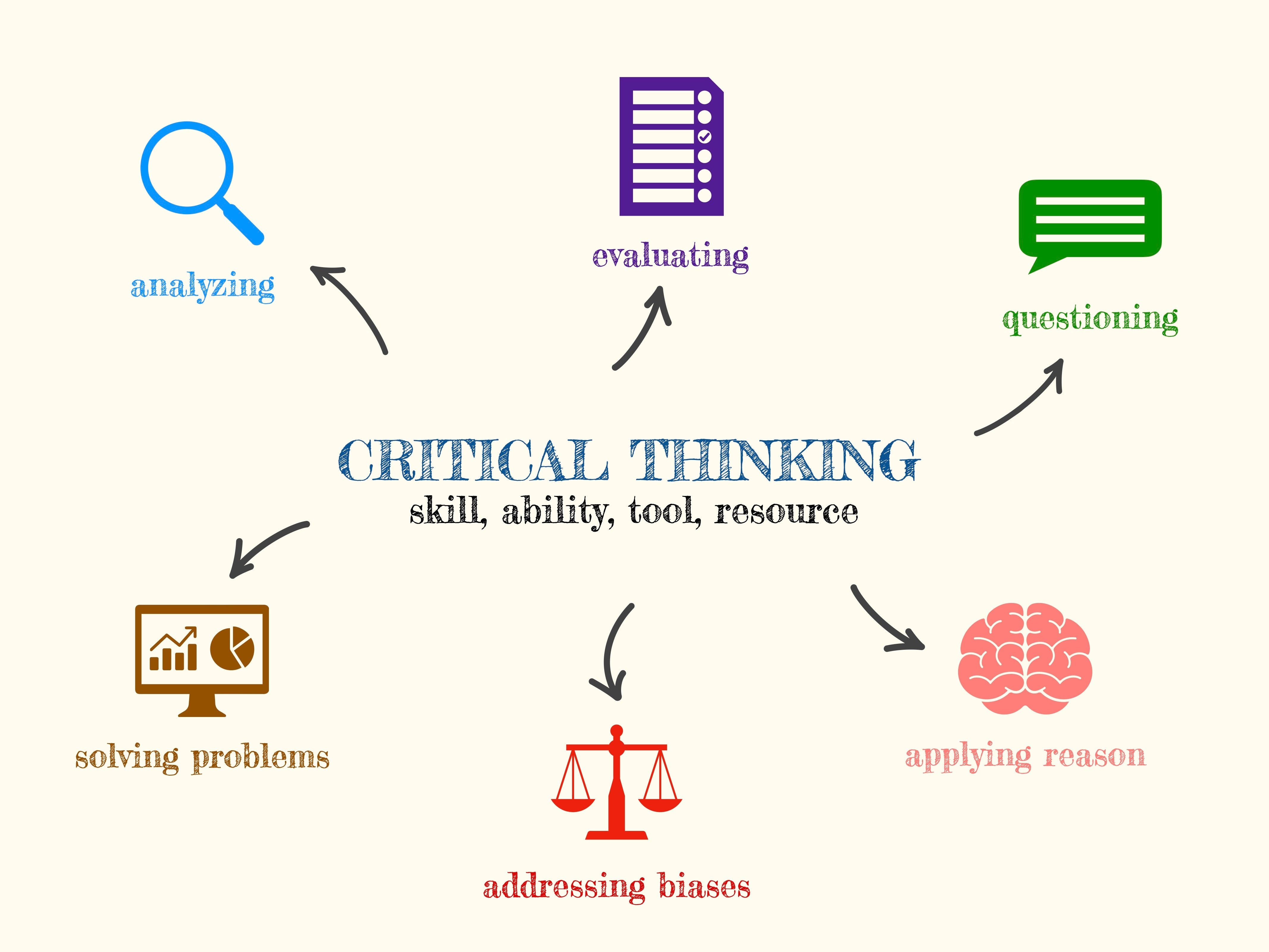
For this article, here’s a current combined definition of critical thinking:

Current overview on critical thinking:
analyzing facts, evidence, and arguments to form judgements and informed choices
evaluating beliefs, information, and making reasoned decisions
applying reason
questioning assumptions to solve problems and discern biases
requires reflective and independent thinking
If you find yourself lacking confidence in your critical thinking abilities or believe you could benefit from a refresher, embracing critical thinking as a vital skill is highly advisable. This foundational tool not only enhances your reasoning capabilities but also empowers you to make informed decisions. Whether you are navigating significant life choices, such as selecting a job that aligns with your values and aspirations or determining the most suitable place to live, critical thinking plays a crucial role. It equips you with the ability to analyze facts and arguments effectively, ensuring that your decisions are grounded in sound reasoning.
What’s Next
In the upcoming articles, this newsletter will delve into the practical applications of critical thinking in everyday scenarios. From the larger, more impactful decisions that shape your career and living situation to the smaller, yet equally important choices—like trying a new hobby or selecting the best products and services—critical thinking serves as a guiding framework. By sharpening this skill, you will be better prepared to evaluate information critically, weigh options thoughtfully, and ultimately make choices that resonate with your personal and professional goals.
Subscribe now to explore how to effectively apply critical thinking in a variety of scenarios, from important decisions like voting to everyday choices such as what to eat for dinner.
CITING THIS ARTICLE
Critical Thinking Brings Context and Clarity. (2026, June 4). Expand Thinking. https://expandthinking.substack.com/p/critical-thinking-brings-context
#CriticalThinking #analysis #origins #decisionmaking #problemsolving
CONTEXTUALIZER
Critical thinking equips you with the essential skills, tools, and resources to effectively confront challenging decisions and navigate the intricate web of life’s obstacles and triumphs.
References
Drew, C. (2022, April 22). 25 Critical Thinking Examples. Helpfulprofessor.com. https://helpfulprofessor.com/critical-thinking-examples/
Guamanga, M. H., Saiz, C., Rivas, S. F., & Bueno, P. M. (2025). Critical thinking and metacognition: pathways to empathy and psychological well-being. Journal of Intelligence, 13(3), 34.
Jaramillo Gómez, D. L., Álvarez Maestre, A. J., Parada Trujillo, A. E., Pérez Fuentes, C. A., Bedoya Ortiz, D. H., & Sanabria Alarcón, R. K. (2025). Determining factors for the development of critical thinking in higher education. Journal of Intelligence, 13(6), 59.
Zeng, X., & Ravindran, L. (2025). Design, implementation, and evaluation of peer feedback to develop students’ critical thinking: A systematic review from 2010 to 2023. Thinking Skills and Creativity, 55, 101691.